Last Updated: November 17, 2026
Quick Summary
RV resort pet policies are set by each park, so the rules differ from one property to the next. Most resorts govern which animals are allowed, how many per site, size and breed limits, leash and cleanup requirements, and fees or deposits. Confirm the rules for your specific unit in writing before you book.
- Most parks cap pets at about two per RV site, with lower limits for cabins.
- Dogs usually must be leashed outside the unit, often at six feet maximum.
- Rabies vaccination proof is typically required for every dog and cat on arrival.
- Waste must be bagged, and unbagged droppings are often treated as a violation.
- Ask whether pet fees are per pet, per site, nightly, or refundable deposits.
Table of Contents
- Which Pets Are Allowed: Dogs, Cats, and Other Household Animals
- RV Park Breed Restrictions List and Prohibited Animals
- RV Resort Pet Vaccination Requirements and Registration
- Leash Rules, Supervision, Waste Cleanup, and Pet Limits
- Long-Term RV Living with Pets: What to Plan For
- Fees, Deposits, and Penalties for Violating Pet Rules
- Booking Your Stay at Cozy Hill RV & Cabin Resort With Your Pet
- Frequently Asked Questions
Cozy Hill RV & Cabin Resort in Weatherford, TX gets asked one question more than any other: what can I bring? Before you pack the dog bed and the cat carrier, it helps to understand that pet policies are not uniform across RV parks. Each resort sets its own rules based on its layout, its insurance, its neighbors and how much responsibility it wants to take for animals on the property.
Pet policy is the set of rules a resort uses to govern animals on its grounds, including which species are allowed, how many, what size and breed, and how owners must control and clean up after them. The rules are usually written into the booking agreement and the park's posted guidelines.
Policies differ for three main reasons. First, site type matters: a full-hookup RV site with its own parking pad is treated differently from a cabin, where a pet may share walls, porches and a common yard with other guests. Second, the property's amenities shape the rules. A resort with a fenced dog park and walking trails can allow more active dogs than one with no designated exercise area. Third, liability and insurance influence what owners will accept, so breed and behavior restrictions often reflect a resort's risk tolerance rather than any judgment about a particular animal.
Many resorts also distinguish between household pets and service animals. Assistance animals are generally not treated as pets under federal disability law, and the Americans with Disabilities Act sets out what businesses may and may not ask (ADA Requirements: Service Animals). You can review the rules directly at ADA guidance for service animals.
A common mistake is assuming that a pet-friendly label means anything goes. "Pet-friendly" usually means pets are permitted under conditions, not that every animal is welcome in every space.
Which Pets Are Allowed: Dogs, Cats, and Other Household Animals
Dogs and cats are the animals most RV resorts accept, but "allowed" rarely means without limits. Most parks set a cap on the number of animals per RV site or cabin, often two, and some restrict size or weight for dogs. Cats are commonly permitted indoors only, and many resorts ask that they be kept in carriers during transport.
Other household animals, such as rabbits, birds, fish or small reptiles, are handled case by case. Some resorts allow caged animals that never leave the unit. Exotic animals, livestock and any animal regarded as dangerous are almost always excluded. Confirm before you travel, because a pet that is welcome at one property may be prohibited at the next.
RV Park Breed Restrictions List and Prohibited Animals
Breed restrictions are among the most common and most frustrating rules for owners. Many resorts exclude breeds they consider aggressive or that carry high liability premiums with insurers. Lists vary widely, so there is no single universal ban.
The practical approach is to ask the resort for its written breed list and whether it reviews exceptions. Some parks will evaluate a dog on temperament, vaccination history and references rather than breed alone. Others apply the list strictly. Get the answer in writing before you book.
RV Resort Pet Vaccination Requirements and Registration
Most resorts require proof of current rabies vaccination for every dog and cat, and some also ask for records covering distemper or other core vaccines. Expect to show a veterinarian's certificate on arrival, and keep a digital copy on your phone in case the office needs it after hours.
Registration is often a short check-in step, sometimes with a pet form and a photo. Ask whether the resort keeps a pet roster, since this affects how quickly staff can respond if an animal gets loose.
Leash Rules, Supervision, Waste Cleanup, and Pet Limits
Leash, supervision, cleanup and limit rules are the four areas where resorts actually enforce pet policy, so it pays to understand not just what the rules say but how they are applied.
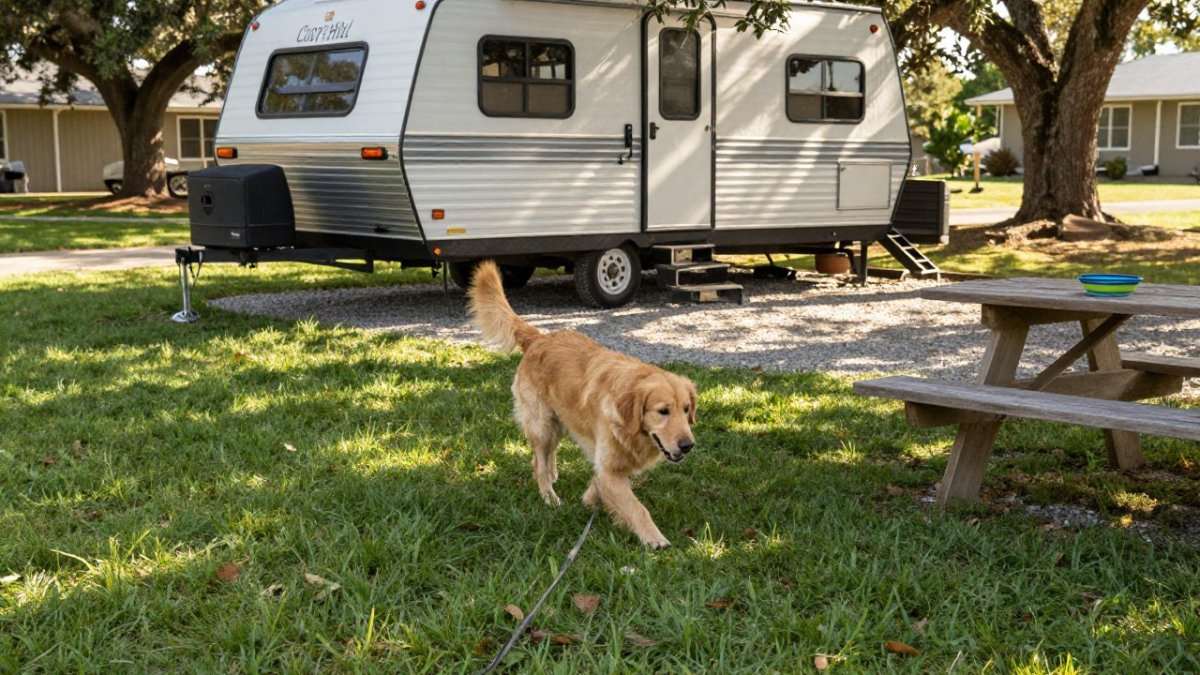
Leash and control. Nearly every resort requires dogs to be on a leash outside the owner's unit, and a six-foot maximum is the most common cap. Retractable leads are frequently prohibited or must be locked short, because a dog on a fully extended cord is hard to control near other guests, bikes and vehicles.
Supervision and unattended pets. Many resorts prohibit leaving pets alone in an RV or cabin for extended periods, since barking can carry across closely spaced sites. A common pattern is a rule that pets may not be left unattended outdoors at any time and may be left indoors only if they do not disturb neighbors.
Waste cleanup. Cleanup is non-negotiable at almost every property. Bring your own bags, use the resort's waste stations, and never leave droppings on shared grass, trails, dog-park edges or another guest's site.
Pet limits and site type. Limits are usually stated per RV site or per rental unit, and the number can differ by accommodation.
Noise, digging and property damage. Barking standards, rules against digging, and prohibitions on pets on resort furniture or beds in rental units are standard. Enforcement typically starts with a verbal or written warning, then a fine, then removal from the property or cancellation without refund if the problem continues.
Watch out: a policy that reads "pets welcome" on a booking page may still cap the number of pets or set other conditions, get the specific rules for your unit in writing before you arrive.
Long-Term RV Living with Pets: What to Plan For
Staying for weeks or months changes the picture. Long-stay guests should check whether the resort's rules differ for monthly residents, whether pet fees are charged per month or per stay, and whether vaccination records need periodic updating. Plan for veterinary care near the property, a local emergency clinic number and a reliable supply of food and medication.
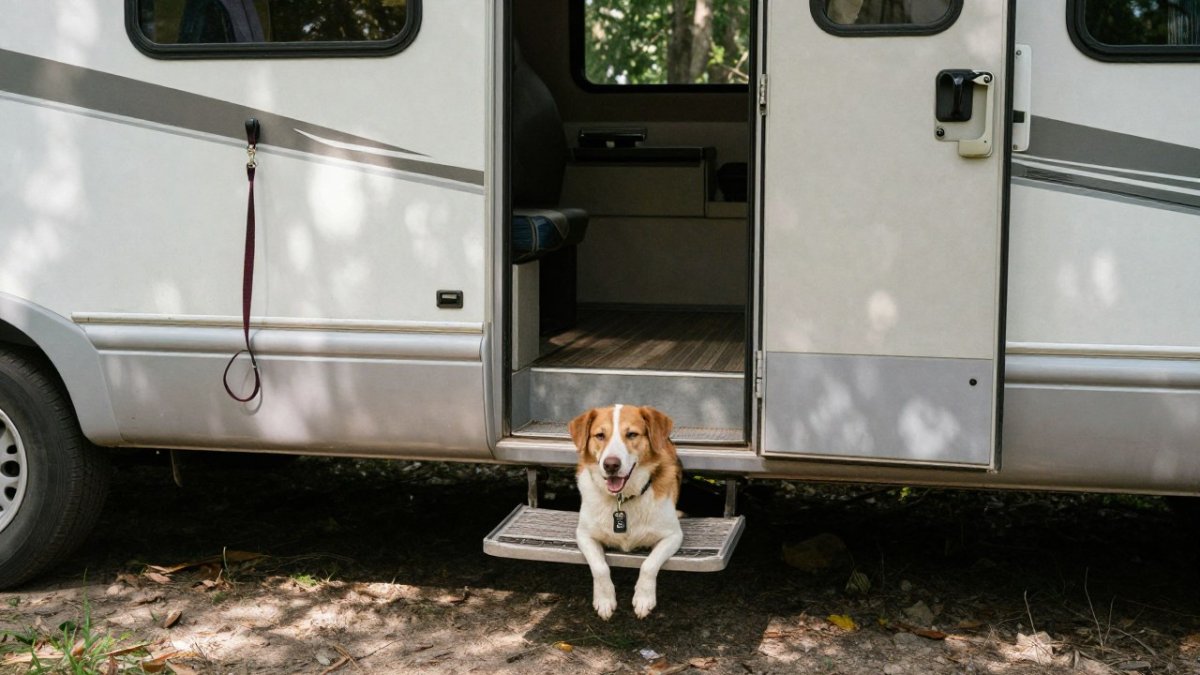
Reliable long-term planning also means keeping your pet's routine steady. Regular walks in the resort's dog park, a consistent feeding schedule and a secure place for the animal during your work hours all help the stay go smoothly. For a broader view of options, compare nearby parks that offer extended sites, such as those listed in RV park directory for long-term stays.
Fees, Deposits, and Penalties for Violating Pet Rules
Pet fees are one of the least standardized parts of RV resort policy, and the structure matters as much as the amount. Ask which of these models applies before you book:
- One-time nonrefundable pet fee, charged per pet or per stay, common for short visits and cabin rentals.
- Nightly or weekly surcharge, added to the site rate for each night a pet is on the property.
- Monthly pet rent, common for long-term RV sites, charged per pet per month alongside the site rate.
- Refundable pet deposit, held against damage or rule violations and returned after inspection, sometimes minus a cleaning charge.
- Per-pet vs. per-site pricing, some resorts charge by the animal, others by the site regardless of count.
Ask exactly what is charged, whether it is per pet or per site, when it is due, and under what conditions a deposit is returned. Get the answer in writing, because a fee quoted at booking and a fee charged at check-in are not always the same number.
Violations and consequences. Enforcement usually escalates rather than jumping straight to eviction. A typical path is a verbal warning, then a written warning, then a fine, then removal from the property or cancellation without refund if the problem continues.
Cancellation terms. Read the cancellation policy alongside the pet policy. If you cancel because a pet is not permitted, the standard cancellation deadlines still apply, and a late cancellation can cost a night or the full stay depending on the park's terms. Confirm whether a pet-related cancellation is treated differently from a ordinary cancellation.
RV site vs. cabin and rental unit. Fees and deposits often differ by accommodation. An RV site may carry a modest per-pet nightly or monthly charge, while a cabin or rental unit may require a larger refundable deposit and a cleaning fee because the pet shares indoor furnishings. Apply the rule for the unit you are actually booking, not the park-wide headline.
The article breaks pet charges into several models, so the table below sets out how each one is typically charged and what to ask before booking.
| Fee model | How it is charged | What to ask |
|---|---|---|
| One-time pet fee | Nonrefundable, per pet or per stay | Is it per pet or per stay? |
| Nightly or weekly surcharge | Added for each night or week a pet stays | Which nights are charged? |
| Monthly pet rent | Per pet, per month, with site rate | Is it charged for long-term sites? |
| Refundable pet deposit | Held against damage, returned after inspection | What is deducted, and when is it returned? |
| Per-pet vs. per-site pricing | Charged by animal or by site | Does the number of pets change the cost? |
Booking Your Stay at Cozy Hill RV & Cabin Resort With Your Pet
Cozy Hill RV & Cabin Resort welcomes pets at its shaded RV sites and cabins, and it offers an on-site dog park. Before booking, confirm the current pet count, breed and size rules for the unit you want, and ask about any fees or deposits. For current monthly RV site rates, including what electricity costs, contact Cozy Hill RV & Cabin Resort or visit its website for a quote, and you can book a shaded full-hookup RV site directly. If a cabin suits you better, explore the furnished cabin accommodations to compare what is included.
Contact the office with your pet's details before you arrive so the team can confirm your reservation and answer any questions in advance.
Frequently Asked Questions
What dog breeds are not allowed in RV parks?
Many RV resorts restrict certain breeds, most often pit bulls, Rottweilers, Doberman Pinschers, German Shepherds, and Chow Chows, because of insurance liability concerns. Restrictions vary by property, so the RV park breed restrictions list is different from one resort to the next. Before you book, ask the front office for the current written policy, and confirm whether mixed breeds that resemble a restricted breed are also excluded. Contact Cozy Hill RV & Cabin Resort directly to ask about its current pet guidelines and breed questions before you arrive.
Are there weight limits or pet limits at RV resorts?
Some RV resorts set a weight limit for dogs, while others allow pets of any size as long as they are leashed and under control. Pet limits are also common, usually one to two animals per site or per rental unit. Weight and number rules can differ between RV sites and cabins, so confirm both before you book. Ask whether the limit applies per site or per unit, and whether any exceptions are possible.
What vaccinations does an RV resort usually require for pets?
RV resort pet vaccination requirements typically include current rabies and distemper vaccinations for dogs, along with rabies for cats. Many resorts ask for vaccination records at check-in and may require a license or registration with the county or city. Bring written proof from your veterinarian, including the vaccination dates and expiration dates. Keeping these records in your RV makes check-in faster and helps if you stay long term, since records may need to be renewed during your stay.
Can I leave my pet alone in my RV at a resort?
Most RV resorts prohibit leaving pets unattended, especially outdoors or for long periods, because barking, overheating, and escape attempts create problems for neighbors and can violate resort rules. Some properties allow short absences if the pet is calm and the RV has adequate ventilation, but policies vary. Plan for pet care while you are out, such as a dog walker or a pet-friendly daycare. Ask the office about the specific rule before you leave your pet alone for any length of time.
